Any vibration is bad, primarily because of the wear and premature failure that it causes. Vibration when in neutral is a problem in the engine, which is particularly bad because it wears out the gaskets. Verify first that the engine is not idling too slowly and then that there is no motion at any engine mount. Rear engine mounts tend to fail first. It is probably wise to replace them in front and rear pairs.
Vibration only when in gear is a problem with the drive train: the transmission, shaft, stuffing box, prop strut, cutless bearing, or the prop itself. Checking these requires the boat to be hauled. Vibration from a damaged prop generally gets worse at higher RPM, whereas vibration from any other cause tends to smooth out at high RPM. Verify that the prop strut is firmly bedded, with no cracks where it joins the hull, and that it does not move in any direction when pushed hard or whacked with a handy piece of driftwood.
Cutless
bearing
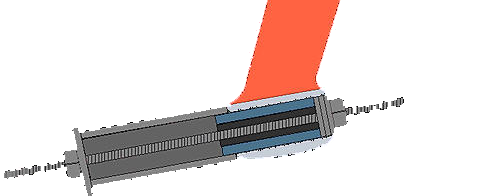
A cutless bearing surrounds the shaft where it passes through the strut. Named after an expired trademark of BF Goodrich, the firm that invented it during WW II as a substitute for metal slave bearings that tended to cut the shaft more, it is spelled without an A and has nothing to do with swords. Cutless bearings last about ten years. The shaft must be centered precisely in the bearing and it should not move even slightly when you grip the prop and shake it hard. If there is a gap around the circumference, look for a matching gap on the other side of the bearing. Matching gaps on opposite sides of the shaft indicate that the shaft is out of alignment. Matching gaps on the same side of the shaft merely show that the bearing needs replacement.To remove a cutless bearing easily, make a tool from a 1-ft length of steel pipe just large enough for the bearing to fit inside it, a 2-ft length of threaded rod, two nuts for the rod, and two pairs of washers, one much larger than the pipe diameter and one just slightly smaller. Put the pipe against the prop strut aft of the bearing, put the rod where the shaft was, put the large washers at the aft end, and tighten the small washers from forward to force the bearing out of the strut and into the pipe.
Shaft
alignment
Shaft alignment most often conjures up a distasteful image of removing the four or more heavily rusted bolts in the shaft coupling and then using a feeler gauge to verify that the coupling has only a few thousandths of an inch of clearance all around. This does not really align the shaft, however; it merely aligns the coupling, and the tolerance really does not matter much as long as it is the same all around (assuming the boat is in the water, not on the hard where hull flexing will throw off any measurement). Think about it: The engine sits on rubber mounts and the somewhat flexible shaft passes through a rubber-lined cutless bearing, both supported by a hull that flexes, so there is surely at least a quarter inch of play along the length of the shaft.A spinning shaft with flexible supports at its ends will tend to self-align through centripetal force, getting straighter as it turns faster, and this is particularly true of the thinner shafts on smaller boats. If this self-alignment does not stress any single points on the cutless bearing, nor bring the shaft into contact with any part of the stuffing box, the alignment is fine. Forget the feeler gauge, therefore, and examine, instead, the point where the shaft exits the stuffing box and, especially, both sides of the cutless bearing. Look for patterns of wear and other signs that the shaft is not staying centered in both. If you can turn the shaft easily by hand in neutral, and it does not bind anywhere, the alignment is probably good.