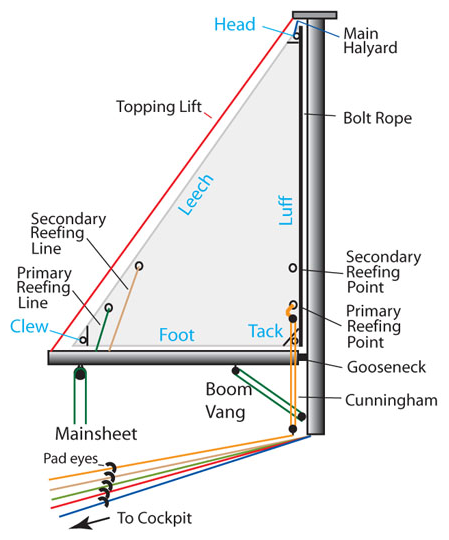
A control line that attaches to a sail is called a sheet. The line that hoists the sail is called a halyard. A Marconi sail, such as the triangular fore-and-aft sails on a conventional Bermuda rig, has three edges (the luff in front, the foot, and the leech) and three points or corners (the head, the tack, and the clew where the sheet attaches). It has a draft, which is the point of maximum bulge or belly, and unless a headsail, it usually has a roach (the part aft of a straight line from the head to the clew). A sail with a roach needs battens to support the roach and keep it from fluttering.
Telltales
The sail also has telltales, little strips that signal, by streaming aft, when their part of the sail is properly trimmed. You want to ease the sheet (or head up) if the leeward telltale is fluttering. Harden up the sheet (or fall off) if the windward telltale is fluttering.Battens
Battens that prevent the roach of a mainsail from fluttering are usually partial, although almost every boat can benefit from full length battens, which support a larger roach for improved light air performance. Full battens reduce flogging and keep the point of maximum draft well forward, in heavy air, for greater forward power and reduced heeling. When used with lazy jacks, full battens make the sail easy to reef or flake as it settles nicely along the boom without flopping over. Their extra support allows use of lighter sailcloth.Drawbacks of fully battened sails are greater difficulty in raising and lowering (because the batten presses against the slides) and difficulty of stowing, along with inability to depower by luffing the sail (because the fully battened sail always catches some wind, even when pointing directly upwind). They are also more expensive, of course, and more prone to rips at the batten pockets.
A mainsail with no roach that needs no battens can work well on a low-aspect ratio rig and is mandatory if the mainsail has roller furling.
Square
sails
A gaff rig has 4-sided sails with a spar, the gaff, at the top. On a square sail, unless they are set fore and aft so that one edge is leading, the head is an edge, rather than a point, and there are two leeches and two clews, but they have no luff and the tack is not part of the sail, it is instead a line that attaches to a clew. When a square sail is set fore and aft, the highest corner is the peak and the topmost edge is the head and the second-highest corner, between the head and the luff, is the throat.How to
trim
sails
When a sail is under-trimmed, it will luff and the windward telltales will flutter. Harden the sheet, or fall off, when under-trimmed or luffing. An over-trimmed sail will stall and its leeward telltales will flutter. Ease the sheet, or head up, when over-trimmed or pinching. In either case, use the sheet when reaching or the helm when beating. A luff is clearly visible, whereas a stall is not at all visible, except perhaps by using telltales, and we therefore trim sails by easing the sheet until the sail luffs and then hardening up just until the luffing stops. Some boats can pinch a little while beating in strong wind and a smooth sea, thereby sailing faster with a slight luff in the jib. On a broad reach or run, the mainsail cannot stall because it has no flow on its leeward face and it is best to fully ease the mainsheet.
Heeling
and helm
As the apparent wind blows against a boat, some of its force moves the boat forward and the rest of its force results in both slipping, which moves the boat sideways, and heeling, which tips the boat to leeward. A boat that sails upright, with no heeling, is balanced and will steer its own course without use of the helm.Any heeling moves the sails off center to leeward and thereby causes weather helm, which makes the boat turn up into the wind. A small amount of weather helm is good when close hauled because it makes steering easier. Too much is bad because it slows the boat while straining both rig and crew. The opposite of weather helm, called lee helm, is rarely seen, always bad, and makes steering much more difficult.
To reduce heeling, and thereby reduce weather helm, you must move the working part of the sails forward. You can reef the mainsail or you can de-power it by flattening it with the Cunningham, trimming it in to stall it, or easing the traveler to spill air. Lee helm is most often seen when sailing under the jib alone and can be countered by raising the mainsail or trimming it properly.
Aspect
ratio
The aspect ratio of a sail is its height (ie, length of the luff), squared, and then divided by the area of the sail. High aspect ratio sails, found on a tall rig with a relatively short boom, give more lift when close hauled and therefore perform better upwind. As the boat falls off to a reach, however, high aspect ratio sails are less efficient and quicker to stall.An aspect ratio of 4 to 6 is best for racing, where performance to windward is critical, but such a high aspect ratio sail will not perform well off the wind and must be augmented with a spinnaker. The best aspect ratio for all around performance in cruising boats is about 2.5 to 3.5, or certainly no more than 4. This lower aspect ratio sail will outperform everywhere except within a few degrees of close hauled. It requires a simpler rig that is longer lasting and easier to maintain.
I J P E
dimensions
The size of a sail and the length of its halyard are defined by the I, J, P, and E dimensions of the boat. If there are two headsails, I and J dimensions for the second will have a subscript 2. If there are two masts, P and E dimensions for the mizzen will have a subscript Y. Some websites that sell sails and rigging can provide these dimensions for many sailboats. To measure them on a boat, use the main and jib halyards to hoist a tape measure, tying on also a line that can pull the halyard back down if the tape breaks. 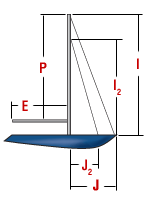
Mainsail
dimensions
When measuring for a mainsail, hoist the end of the tape to the top of the mast and measure the maximum luff dimension to the top of the boom near the mast. Measure the max leech dimension to the clew attachment point, at the end of the boom, with the topping lift set for working boom height and the outhaul fully back. Lower the tape and measure the max foot dimension from the tack attachment to the clew attachment. All three of these dimensions should be as large as possible without being too large. Lastly, measure the horizontal and vertical tack offsets, the distances from the tack attachment point to the back of the mast and the top of the boom. The mainsail luff attaches to the mast on an internal track, an internal slot, or an external track. An internal track takes rectangular slides of the appropriate width. An internal slot takes either a bolt rope or barrel shaped slugs of appropriate diameter. An external track takes C-shaped slides of appropriate width.
Headsail
dimensions
When measuring for a hanked-on headsail, hoist the end of the tape on the headsail halyard and measure the maximum luff to the deck near the base of the forestay where the tack attaches. This is the critical dimension that must not be exceeded. Measure the I dimension to the deck (not the top of the cabin or house) near the mast. Lower the tape and measure the J dimension from the base of the mast to the base of the forestay. Measuring for a roller furled headsail is the same except for the maximum luff. Attach the end of the tape measure to the bottom of the furler’s top spindle, where the head of the jib will attach; raise it all the way; and measure down to the tack attachment point above the furling drum. The luff must be long enough to hoist the head swivel fully aloft, and thus prevent the halyard from wrapping around the forestay, but not so long that it cannot be tensioned, even after it stretches with use. (Attaching a short pendant between the head of the sail and the furler’s head swivel can get the head swivel up high enough to prevent halyard wrap, and the pendant can be shortened or removed as the luff stretches over time.) You must determine, also, the diameter of the luff tape that slides into the foil all along the luff. Lastly, decide whether the sail will furl clockwise (as is customary) or counter-clockwise; this determines which side will have the UV cover.
Only if the jib turning block or fairlead is fixed, rather than on a track, or if the track does not extend far enough forward or aft, a sailmaker will also want to know the distance from the head of the jib to the turning block or the distances from the head to the front and back of the track.