Rope is a substance that magically changes into line when brought aboard. There are very few ropes on a boat: The bell rope that rings a bell and the tiller rope that secures a tiller are all that a modern sailor is likely to encounter. Once put to use, line assumes the name of the rigging part that it has become. It will typically have a standing end that is made fast to an object and a bitter end that hangs free.
Ropes differ in material and in construction. The material used determines both strength, which is always desirable, and elasticity or stretch, which is sometimes wanted and sometimes not wanted. Construction—whether 3-strand or laid line, single braid, or double braid—mainly determines ease of handling. Most lines, today, are double braid except for dock lines and anchor rode, where stretchy laid line is more common.
Laid line
Laid line has three strands, each made of twisted fibers. The lay of the rope can be left-laid, or S-laid, if the strands form an S shape down the length of the rope, or it can be right-, or Z-laid. Most laid line is Z-laid. Within each strand, the fibers are laid opposite to the lay of the strands.Laid line must be coiled with the lay, either clockwise if Z-laid or counter-clockwise if S-laid. It is the easiest kind of line to splice. When it is cut, the bitter end must be whipped to prevent the three strands from unraveling, or coming unlaid.
Braided line
Braided line can be single braid, called hollow core and found mostly in small diameters, or double braid, which is the more common kind. It is stronger than laid line, does not stretch as much, passes more smoothly through a block, and can be coiled in either direction. It is more difficult to splice, however, and more susceptible to chafe.Three types of double braid are:
- Parallel core — a braided cover over straight strands of fiber; strongest.
- Multibraid — two pairs of Z-laid and two pairs of S-laid strands; most flexible.
- Braid on braid — a braided cover over a braided core; least stretch.
Polypropylene
line
The main advantage of polypropylene rope is that it floats and therefore cannot foul the prop. It is also colorful, therefore easy to see, and low in cost. Drawbacks are that it degrades quickly in sunlight, wears out quickly, is difficult to cleat, and its fibers can cut your hands and jam in blocks. It is not suitable for most applications on a sailboat except, perhaps, as a dinghy painter or mooring pennant. Nylon line
The main advantage of nylon rope is that it can stretch, sometimes up to 40%, thereby absorbing shocks that might damage a cleat. It can lose a quarter of its strength when wet. Laid line made of nylon is used for dock lines and anchor rode where stretch is wanted.Polyester line
Most double braid is made of polyester (eg, Dacron). It is almost as strong as nylon, but it stretches less and loses no strength when wet. Some kinds have the great strength needed for sheets. Other kinds have the low stretch needed for halyards. Some kinds have both. The maker of a polyester double braid might provide explicit instructions for splicing it.How to
cut rope
When nylon double braid is cut, the outer braid begins to unravel and the inner braid then separates into a tangled plume of fibers. Applying flame to the cut end is a poor solution, and dangerous besides, particularly if the flame is from a cigarette lighter. Rigging shops cut their rope with a hot knife, which is a tool much like a soldering iron. You can do just as well, or better, by heating a kitchen knife over a gas stove burner.Choose a sharp, preferably serrated, knife with a heat-proof handle, one that can be discarded after this use. Apply a few turns of electrical tape to the site of the cut and use the heated knife to make a series of small cuts at the center of the tape, working around the rope from the outside in and reheating the knife after each tiny cut.
Whipping
The bitter end of a rope should be whipped to prevent it from unraveling. The best time to apply whipping is before cutting the rope. Electrical tape can be used in a pinch, but special whipping twine is better and lasts far longer.A handy method that does not require a needle is the west country whipping. Lay the rope across a yard-long length of whipping twine, bring the ends of the twine up, make a simple overhand knot, and snug it down. Then use the twine ends to flip the rope over, so the knot is on the bottom, and repeat. Continue about 20 times, snugging each loop into place, and finish with a reef knot. Cut the rope far enough from the whipping that you can fuse the bitter end without charring the twine. Use a hot knife or, in a pinch, fuse it in a hot blue flame, such as a propane flame, taking care to avoid drips of rope material.
A west country whipping can be used on other objects besides rope—such as a knife handle or a control lever—as decoration or to give a better grip. For a chunkier and more robust look, use a double overhand knot (surgeon’s knot). Instead of whipping twine, try using paracord for decorative whipping. Paracord whipped around itself can make lanyards or bracelets where the paired overhand knots are called a cobra knot. YouTube videos show how.
Chafe guards
Wherever rope contacts a hard surface it will chafe, and when it chafes, eventuallly it will fail. Chafe guards are tough but flexible materials that can be wrapped around lines at points where they chafe. The chafe guard must attach firmly to either the line or the hard point that it rubs against to prevent it from moving along the line.The best and least expensive chafe guard is a piece of hose and almost any kind will do. Splitting it lengthwise with a knife avoids having to thread it onto the line. The best way to secure it is with one or two pieces of thin but stout line threaded through holes near the hose ends and tied firmly to either the line or the hard point. Used fire hose, available at low cost through online auction sites, is a good option. Duct tape is not.
Strength
of rope
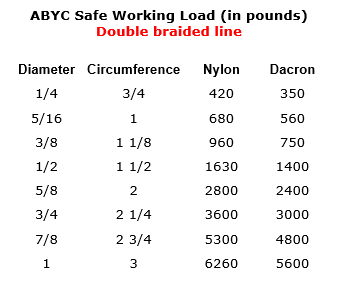
Strength of rope is expressed as maximum load, or breaking strength, and also as safe working load, which is generally about one-fifth of the breaking strength. Although rarely seen on sailboats nowadays, manila rope is the standard against which all other rope is compared. Manila rope has a breaking strength, in pounds, of 900 times the square of its circumference in inches. Polypropylene has 1.4 times the breaking strength of manila rope. Polyester has twice the breaking strength of manila and nylon has 2.5 times its breaking strength. A broken rope is rarely wanted, however, and the tables instead give the safe working load for each kind of rope by diameter.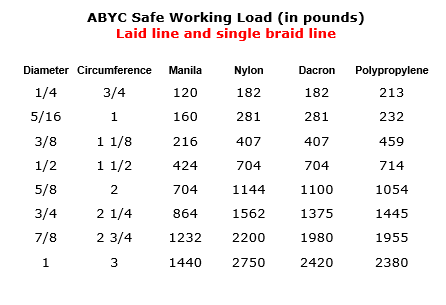
Heaving
a line
You can only throw a line about 20 ft. Attempting a longer throw will just embarrass you and likely wet the line. Before throwing, separate the line into two coils, one holding about 30 ft of line in your throwing hand and the other holding the rest of the line in your other hand. Throw the coil with a long, sweeping, underhand motion, using lots of follow through, and aim high so it falls onto the catcher as it passes overhead.After catching a heaved line, do not just stand there and hold it. Quickly run it free of obstacles, such as lifelines, and cleat it off.