
Since not enough can be said about safety, we will say as little as possible. Whole books have been written on this subject and they are worth reading. What follow are only some concise tips that might easily be overlooked.
Fire
extinguishers
All except the smallest boats need fire extinguishers. There must be the right number of them, based on boat length, and they must be USCG approved types that are properly located and maintained.At the
dock
Turn off AC power at the dock pedestal (not the boat’s AC breaker, although that ought to be off also) before unplugging the shore power line from the boat.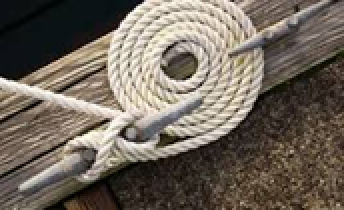
Neatly coil or flemish the bitter ends of dock lines, both onboard and, especially, on the dock. If you leave a loose pile of line and someone trips, it will be your fault.
Turn off shore water whenever leaving the boat or, better still, use the dock hose only to fill the water tanks and then pump water from the tanks. Running the water pump often in this way will make it last longer. Do not walk off and leave a tank filling, as it might overflow into the boat.
When leaving the boat, ensure that the VHF radio is turned off, all lights including instrument lights are off, and no halyard can slap the mast. Neglecting any of these will annoy neighboring boats.
Do not operate a high wattage appliance, such as an electric heater, through the main electrical panel. Instead, run a dedicated 3-prong extension cord ashore to the dock pedestal.
Man
overboard
Know the man overboard drill and practice it often.- When someone falls overboard, immediately throw them a flotation device (or two). It can be the throwable PFD that every boat over 26 feet long must carry, or a fender, or even a cockpit cushion. Besides flotation, it will aid in finding the victim.
- Have a crew member note and record your GPS position. Trigger the man overboard (MOB) feature of your GPS or chart plotter, if it has one.
- Alert everyone onboard and assign one crew to watch the victim constantly, pointing toward them all the while. If you lose sight of them as the boat turns, it can be difficult to find them again.
- Turn back and bring the boat to a stop, heading into the wind, alongside the victim. If beating, fall off and gybe. If running, head up and tack. Approach the victim from leeward so that the wind blows them toward the boat and the sails do not obstruct your view of them. Do not approach so close that you run them over.
Practice this drill by tossing a fender or PFD into the water and then turning back to retrieve it. Practice without using the engine even though you will of course use the engine when you can. Should you be the skipper, have another crew member practice also, in case it is you who goes overboard.